- Problem
- Translating Korean education content into Vietnamese looked like one problem — 'translation quality.' Open it up and there were three different ones: context drifting across hundreds of thousands of characters, errors with no clear owner, and reviewers reading all night — plus whether paper textbooks could become data at all (OCR). The idea that one good model would solve it died in week one.
- Role
- I ran the whole prototype solo: translation process and AI workflow design, prompts, review criteria, the ePub prototype and OCR pipeline, and the actual review and quality control. Outsource it and you get a delivery, not a validation.
- Process
- The first fork was model choice. All-large: quality holds, cost explodes at novel scale. All-small: cost works, prose drifts chapter to chapter. The answer was hierarchy — a large model holds direction and instruction consistency while small models do the work in parallel. Consistency held under parallelism and the human review pass rate rose. The second concern was the reviewer: 'read everything, then judge' became a state design (resolved / recurred / warning) so reviewers only judged. And OCR didn't start with a pipeline — an accuracy test confirmed 'whether' in numbers before building 'how.'
- Result
- Time and cost came down; the human review pass rate went up. But the real yield was where the next failure lived: not the model — operating human reviewers and reporting upward. I learned early that after validating the technology, you have to design the organization.
Keduall · AI Prototyping · Dec 2025 – Apr 2026
Translation & OCR Prototype
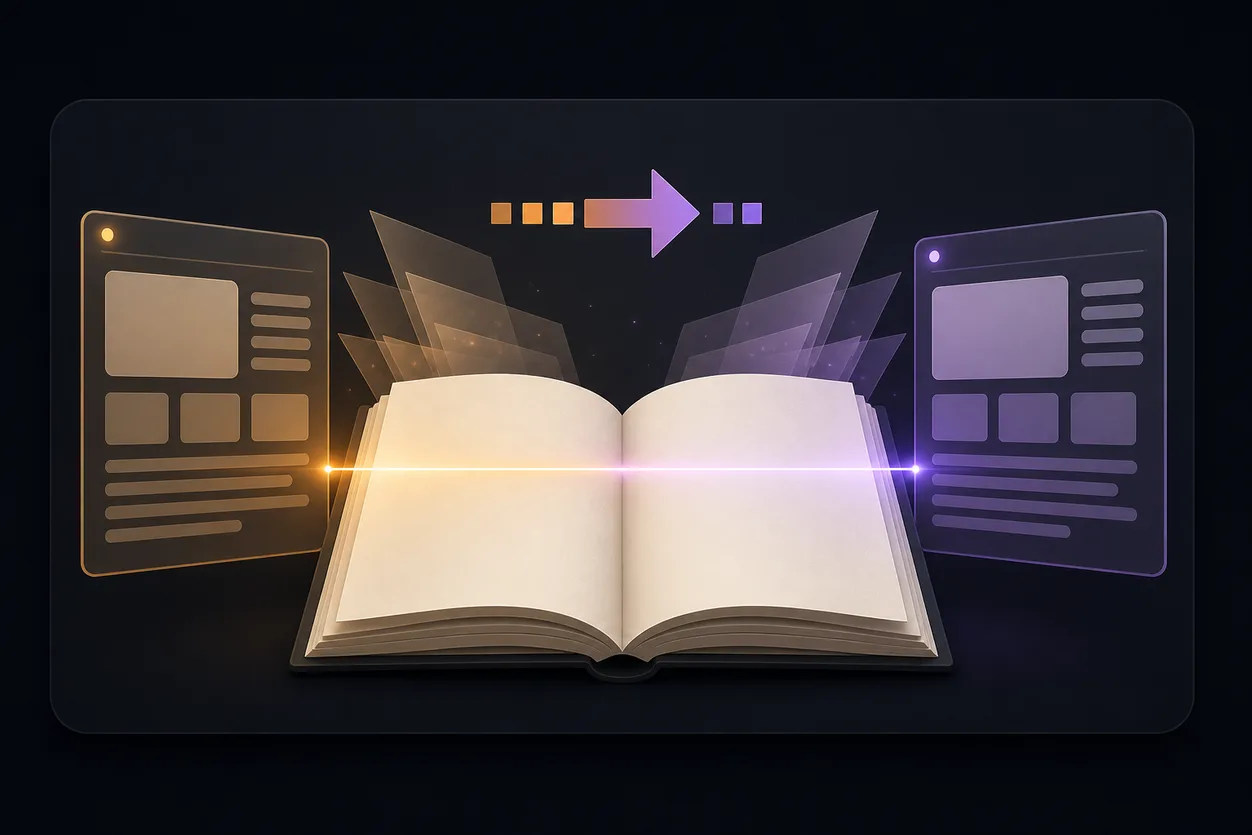
Prototypes that validated taking Korean education content global. I built an ePub multilingual translation tool with an LLM re-review flow, and an OCR pipeline for digitizing textbook PDFs — planned, developed, and benchmark-tested by myself.